Friday, 18 September 2015

Stop Motion

Stop Motion


Stop motion is an animation technique it first came about in the late 1800's.  Albert E. Smith and J. Stuart Blackton are thought to be the inventors of stop motion, one of if not the first stop animation film is The Humpty Dumpty Circus (1898).  This form of animation is still being used to this day and keeps getting better with all the new technology helping aid bring stop animation to life.

The principle of stop animation is very simple yet holds a level of complexity at the same time.

The are a few different variations of stop motion such as claymation (Wallace & Gromit).

Cutout animation (El Apostol) and puppet animation (Nightmare before Christmas).

It is basically a bunch of images of the same scene but every scene is different from the last to create the illusion that it is alive, it's usually 12 frames per second, so as you can imagine it is a very time consuming process but can be made from the comfort of your own home, all you need is a camera, some paper or clay or even some puppets and a whole lot of time.
You'd also need a tiny amount of editing skills I'd say.

The advantages are its cheap, the possibilities are endless and its still very much in fashion.
The disadvantages are that it takes a very long time for a very short video, you need to be quite artistic and have the correct resources.


Here we see a very creative modern day use of stop motion


Here is a behind the scenes video from The nightmare before Christmas.  It shows us how using puppets for stop animation works and shows us how there are even changeable faces to help bring the illusion to life


Friday, 11 September 2015

The flipbook

The Flipbook


A brief history

The first flipbook appeared in September 1868 patented by John Barnes Linnett under the name 'kineograph' (MOVING PICTURE) although the French Pierre-Hubert Desvignes is generally credited with being the inventor of the flipbook. After Linnett died his wife sold the patent to an American.

How it works

It's pretty much just a lot of drawings that when flipped they give off the illusion that you're watching some sort of short animated movie. 

"The books are designed so that each page’s image advances the scene from the previous page; when the pages are thumbed rapidly the sequence becomes animated due to the persistence of vision." ~ history of the museum of science

What you need to make it work

You only need very basic materials to make a flipbook;
A pencil or pen
A sharpener 
An eraser 
A lot of paper 
Coloured pens or pencils (optional)

Although flipbooks are ideal and very cost efficient to make there are a few quite big draw backs for example, because they are made of paper they're prone to damage and don't have much in the way of life expectancy, they take a massive amount of time and patience to make a half decent one and lastly you need to be a pretty good artist to produce a good final outcome.


Here are a few flipbook examples


Friday, 4 September 2015

Zoetrope of dreams

The Zoetrope


What is a Zoetrope?

Some sources claim the Chinese inventor Ting Huan invented the device first in 180 AD.  His version hung over a lamp and would turn from the hot air currents that the lamp produced (although this is believed to be lies).   In the western world, the zoetrope was reinvented in 1834 by the British mathematician William George Horner (1786-1837). He called his invention the "daedalum" or “Wheel of the Devil.”

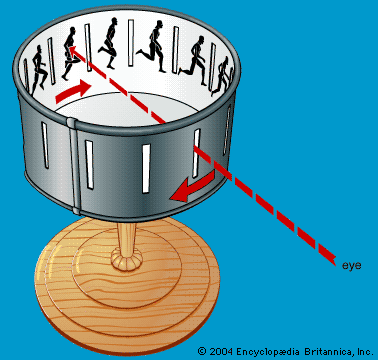
The Zoetrope produces the illusion of movement by viewing individual images through narrow slits in a rotating cylinder.  The cylinder is often made of cardboard because it's a cheap readily available material so people could make it in their homes given they had the few resources required and a degree of artistic ability.


How is it made?

First you'd get a cardboard cylinder with a solid bottom on it and evenly cut slits into the sides all the way round. 
Then you'd get a small piece of card or paper the same length as the circumference of the cylinder.  On this card would have a series of images drawn all slightly different. 
The strip of paper would be placed into the cylinder.
In the centre of the bottom of the cylinder a small hole would be cut and a stick or something of the sort would be inserted with a good enough fit that you could hold up the whole thing by the stick then you could spin it in your hands, this of course is only a cheap homemade variation of the toy.  
Some versions of the toy have wheel mechanisms that you would crank with your hand to spin the Zoetrope.

Advantages - could be made in the comfort of your own home, if you're artistic the designs are endless, offers more entertainment than its predecessor.
Disadvantages  - If you can't draw then you're going to have a bad Zoetrope and people will make fun of you.


Homemade Zoetrope in action


Friday, 28 August 2015

Thaunatrope

Thaumatrope

What is a Thaumatrope?

Thaumatropes were the first of many optical illusion toys. John A. Paris was responsible for the creation of the toy in 1825.  Thaumatrope means "wonder turner" or "turning marvel" they provided a form of animation until the development of the cinema came into action.


The design was simple and easy to make, all that was required was a circle piece of cardboard or something of the sort, a few pieces of string and a pencil to draw the designs.
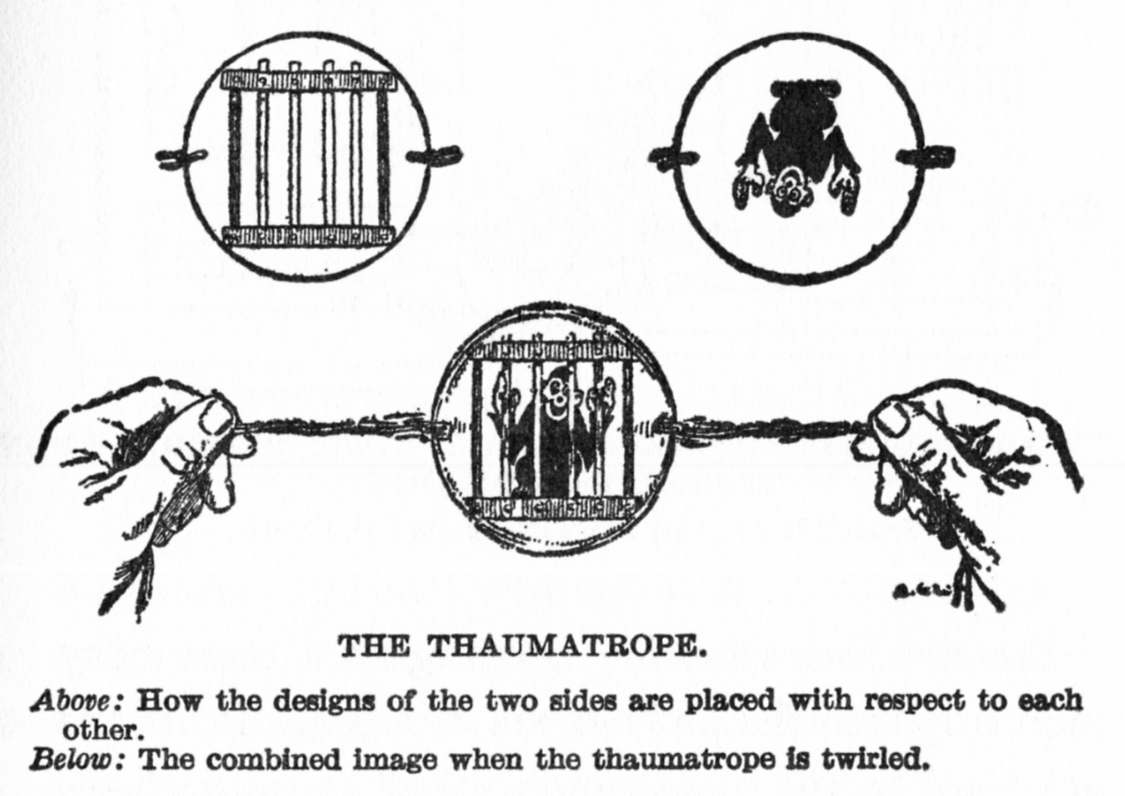
Each side had an image drawn on it so when spun it gave of the impression that the two images are one, the faster the disc is spun the more convincing the illusion becomes.

How does it work?

To spin the disc, a string is held in each hand and rotated to wind the disc, the illusion would be kept alive by gently stretching the strings so that they would continue to unwind and rewind.

Advantages - Easy to make, easy to use, cheap to make, the designs could be limitless to the right people.
Disadvantages - For the best quality you'd need to be a good artist to some extent.

Two well known examples of the Thaumatrope would be the bird in a cage and a dog scaring some birds.


Examples of modern day Thaumatropes


                                          Here we can see many different designs and how
                                          they are used.